
Family Engagement: Essential Conditions
Essential Conditions for Building Effective Family-School Partnerships
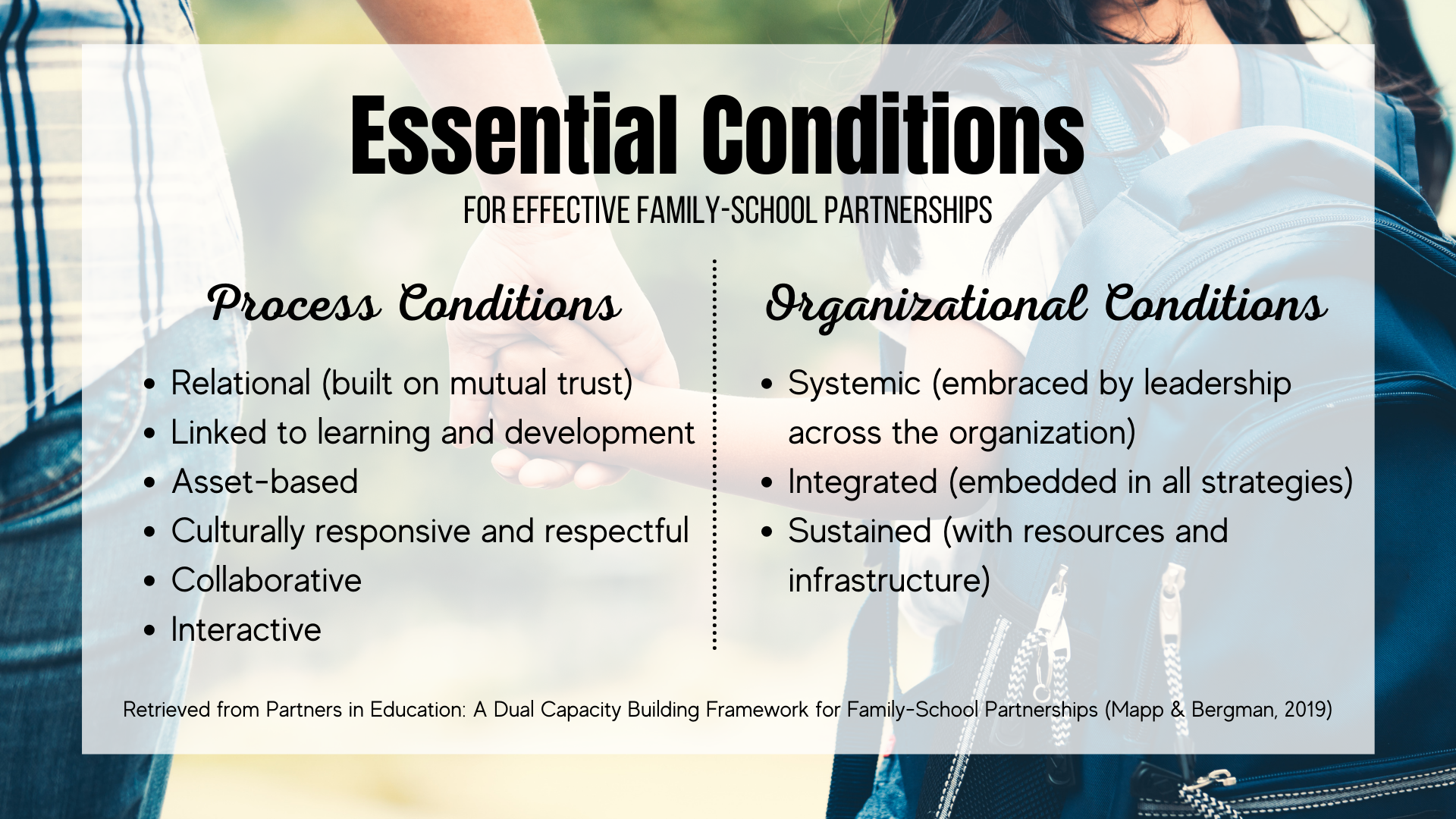
Essential Conditions include both process and organizational conditions.
Process Conditions
"Research suggests that certain process conditions must be met for adult participants to come away from a learning experience not only with new knowledge but with the ability and desire to apply what they have learned. Process conditions are key to the design of effective initiatives for building the capacity of families and school staff to partner in ways that support student achievement and school improvement" (p. 9, Mapp & Kuttner, 2013). Initiatives must be:
- Relational (built on mutual trust)
- Linked to learning and development
- Asset-based
- Culturally responsive and respectful
- Collaborative
- Interactive
Organizational Conditions
"In addition to process conditions, important organizational conditions must be met in order to sustain and scale these efforts across districts and groups of schools" (p. 9, Mapp & Kuttner, 2013). Organizational conditions must support fidelity, sustainability, and scale-up of initiatives designed to bolster family-school partnerships. Initiatives must be:
- Systemic (embraced by leadership across the organization)
- Integrated (embedded in all strategies)
- Sustained (with resources and infrastructure)
How MTSS Supports Schools and Families in Meeting Essential Conditions
- Successful MTSS implementation relies on mutual trust among stakeholders. Establishing effective family-school partnerships requires that families reciprocate this trust.
- MTSS aligns strongly with learning and development goals. Both MTSS and the Dual Capacity-Building Framework emphasize focusing on community and family assets.
- MTSS practices are evidence-based, culturally and linguistically responsive, and aligned with student needs. This aligns with the essential condition of culturally respectful initiatives aimed at increasing family-school partnerships.
- MTSS promotes organizational conditions for systems change, including leadership involvement, integration into existing work, and sustained efforts through resources such as time and training. These reflect the essential organizational factors in the Dual Capacity-Building Framework.

The Challenge
Return to The Challenge for a refresher on capacity challenges for schools and families.
The Challenge
Policy and Program Goals
Review goals needed for effective family-school partnerships and understand their role in building capacity.
Policy and Program Goals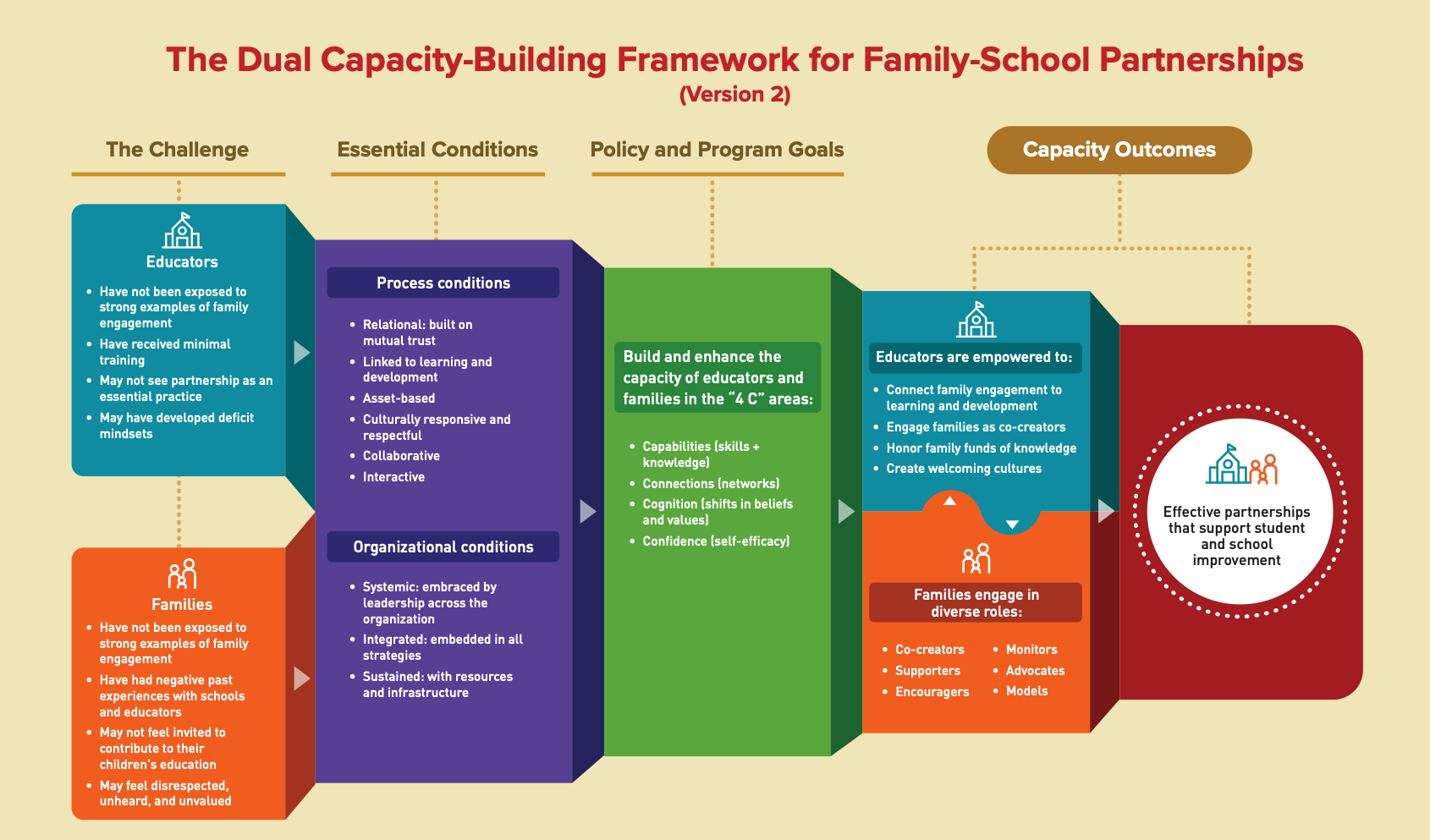
The Framework
Learn more about the Essential Conditions in the Dual Capacity-Building Framework for Family-School Partnerships.
The Framework1 United States Department of Education. Mapp, K. L., & Kuttner, P. J. (2013). Partners in Education: A Dual Capacity-Building Framework for Family-School Partnerships. Available from https://www2.ed.gov/documents/family-community/partners-education.pdf; accessed 10 February 2021.
2 Mapp, K.L. & Bergman, E. (2019). Dual capacity-building framework for family-school partnerships (Version 2). Available at www.dualcapacity.org.