
Family Engagement: Policy and Program Goals
Building the 4 C's of Capacity for Family-School Partnerships
The Framework builds on research showing that partnerships between home and school can only thrive if both families and staff have the collective capacity to engage. Initiatives that focus solely on families often increase tension when schools are unwelcoming. Policies and programs must focus on building capacities of both staff and families to engage in partnerships.
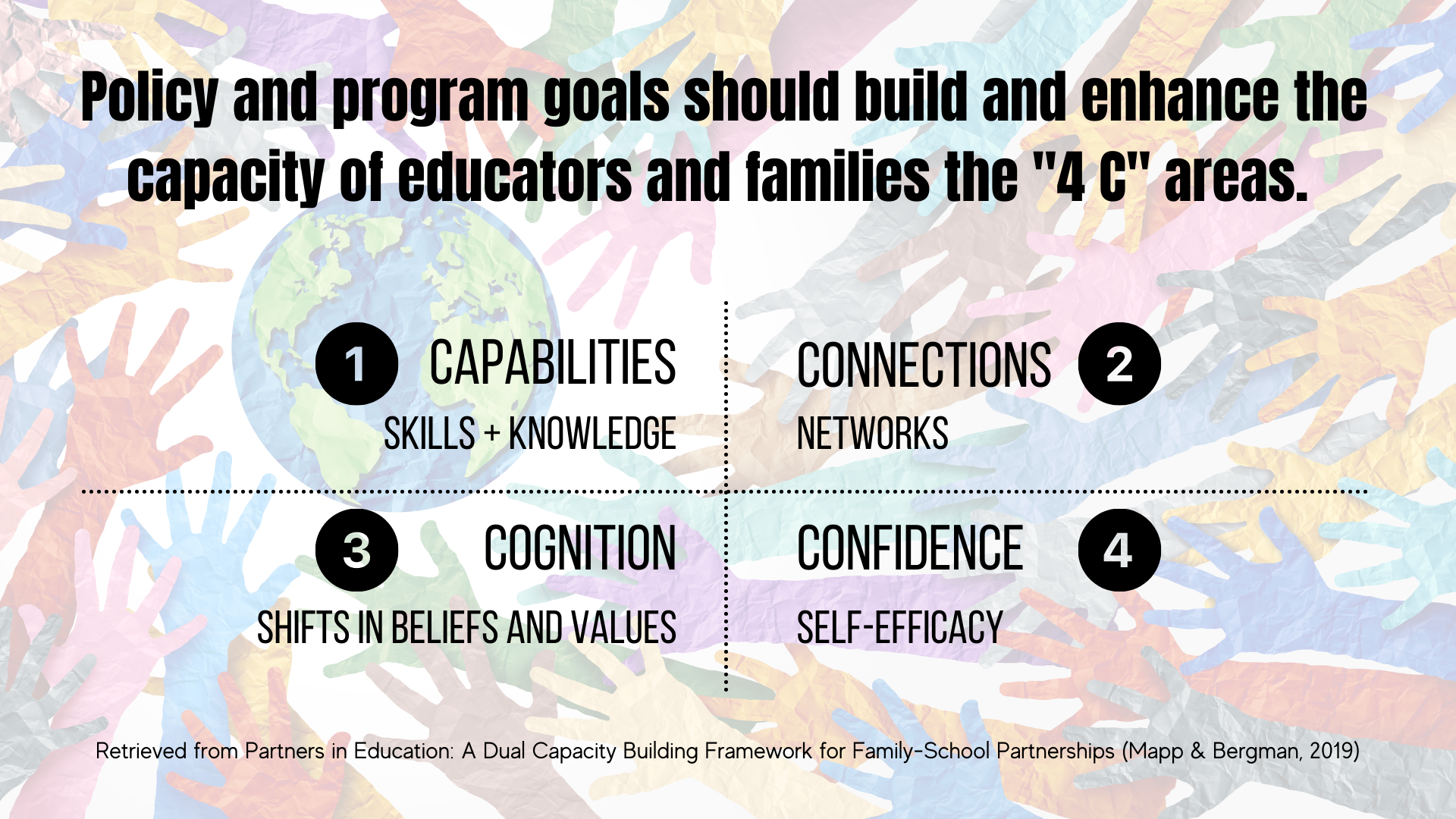
What are the "4 C" areas?
Read on for more details (p. 10-11, Mapp & Kuttner, 2013).
| 4 C's Areas |
|---|
| Capabilities (skills + knowledge) "School and district staff need to know the assets and funds of knowledge in the communities. Families need knowledge about student learning and school systems, as well as advocacy skills." |
| Connections (networks) "Staff and families need access to social capital through strong, cross-cultural networks built on trust and respect, including family-teacher, parent-parent, and community connections." |
| Cognition (shifts in beliefs and values) "Staff must value partnerships with families. Families must see themselves as partners in their children’s education, embracing multiple roles described in the Framework." |
| Confidence (self-efficacy) "Staff and families need comfort and self-efficacy to engage in partnership activities and work across cultural differences." |
How MTSS Supports Schools and Families in Building the 4 C's
- Evidence-based practices build the 4 C's. For example, staff need cultural competency skills, delivered through evidence-based professional learning tailored to the community served.
- Leaders must ensure systems exist to give staff time and space to train, implement practices, and reflect. Families also need opportunities to develop collaboration skills and build networks.
- Data guides decision-making. The 4 C's provide criteria for measuring policy and program effectiveness, including engagement comfort, diversity in leadership, trust levels, and staff knowledge of culturally responsive practices.

Essential Conditions
Return to the Essential Conditions for a refresher on process and organizational conditions needed for effective family-school partnerships.
Essential Conditions
Capacity Outcomes
Review the Capacity Outcomes that emerge when Essential Conditions are met and Policy and Program Goals established.
Capacity Outcomes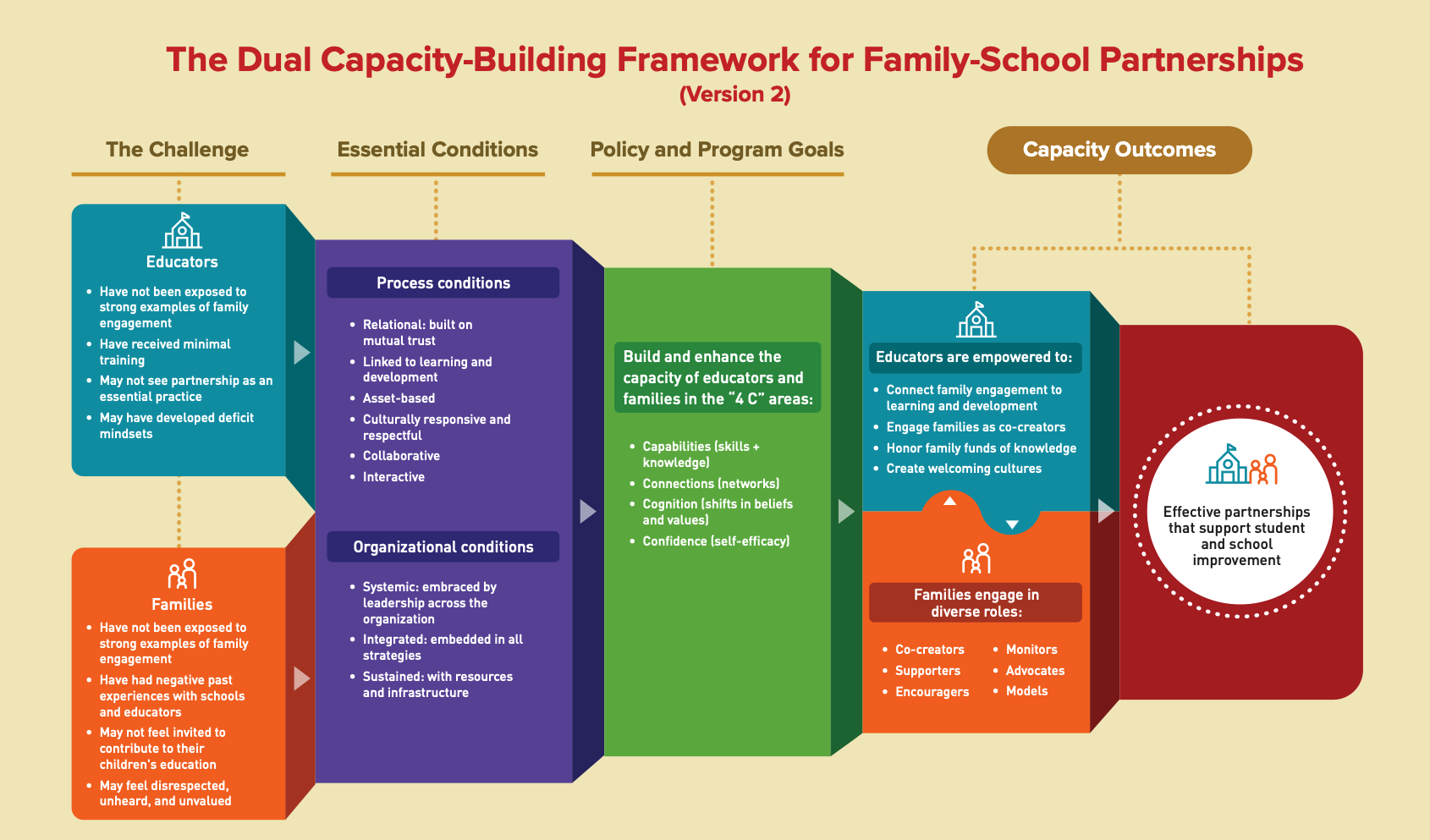
The Framework
For resources on setting goals on the 4 C’s, visit the Dual Capacity-Building Framework Policy and Program Goals page.
The FrameworkIn addition to the Dual Capacity-Building Framework measurement ideas, schools can use existing data sources such as RIDE's SurveyWorks .
1 United States Department of Education. Mapp, K. L., & Kuttner, P. J. (2013). Partners in Education: A Dual Capacity-Building Framework for Family-School Partnerships. Available from https://www2.ed.gov/documents/family-community/partners-education.pdf ; accessed 10 February 2021.
2 Mapp, K.L. & Bergman, E. (2019). Dual capacity-building framework for family-school partnerships (Version 2). Available at www.dualcapacity.org .